[EXPERT INSIGHTS] Dispute Avoidance Mechanisms
Why preventing disputes matters more than resolving them

Construction projects are inherently complex undertakings. Multiple stakeholders, long timelines, technical uncertainties and significant financial commitments create an environment where disagreements can easily emerge. When these disagreements escalate into formal disputes, claims or litigation, the consequences are often severe—delays, rising costs and damaged professional relationships.
For this reason, modern project management increasingly emphasises dispute avoidance rather than dispute resolution. Effective dispute avoidance mechanisms aim to identify potential issues early, prevent escalation and encourage collaborative solutions before conflicts become formal claims. When implemented properly, these mechanisms save time, protect project budgets and maintain working relationships among project stakeholders. Dispute avoidance is therefore not a single tool or contractual clause. It is a structured system built on early identification of issues, transparent communication, proactive management and continuous monitoring throughout the project lifecycle.
The foundation: dispute avoidance before the contract is signed
Many disputes originate long before construction begins. The pre-contract stage is therefore critical in preventing future conflicts.
One of the most important elements is clear contract documentation. Accurate drawings, detailed specifications and properly prepared Bills of Quantities help reduce ambiguity. Clear allocation of risks—such as ground conditions, delays or variations—ensures that responsibilities are understood from the outset. When roles, deliverables and obligations are clearly defined, misunderstandings are far less likely to arise.
Equally important is the selection of the appropriate contract form. Choosing the correct contractual framework—whether FIDIC, NEC, JCT or another system—should reflect the project’s complexity, procurement method and risk profile. Some contract structures, particularly FIDIC forms, are specifically designed to encourage proactive collaboration and reduce the likelihood of disputes.
Another essential step is pre-tender clarification. Tender queries, pre-bid meetings and early contractor involvement allow bidders to fully understand project expectations. Addressing ambiguities at this stage ensures that all parties share the same interpretation of the project scope before signing the contract.
Managing risks during project execution
Even with well-structured contracts, disputes can arise during construction. Effective project execution mechanisms are therefore critical.
A key factor is effective communication protocols. Clear reporting lines, regular site meetings and the use of digital collaboration platforms ensure that information flows efficiently among stakeholders. Miscommunication remains one of the most common sources of disputes in construction projects.
Many projects also benefit from early warning systems, allowing project participants to flag potential issues before they escalate. Early identification of risks is essential to prevent disagreements from developing into formal claims.
Similarly, structured risk management frameworks—including risk registers and periodic risk-review workshops—help project teams anticipate potential problems and mitigate them proactively.
Another essential mechanism is robust change and variation management procedures. Clear processes must exist for identifying changes, assessing costs, approving variations and evaluating programme impacts. Poor variation management remains one of the most frequent sources of contractual claims in construction projects.
Finally, real-time project controls supported by technology—such as BIM, project management software, schedule tracking tools and cost dashboards—help ensure that decisions are based on accurate and transparent data. Reliable information reduces disputes about facts and improves project governance.
The human factor: relationships and leadership
Beyond technical systems and contractual procedures, dispute avoidance is strongly influenced by human relationships.
Many organisations increasingly adopt partnering and collaborative contracting models. These frameworks promote shared objectives, open-book costing and joint decision-making processes. Structured partnering workshops help align expectations and foster trust among project stakeholders.
Leadership also plays a decisive role. Strong project leadership can prevent disputes by encouraging open dialogue, promoting a problem-solving culture and establishing a no-blame environment. In many cases, interpersonal issues rather than technical disagreements are the root cause of disputes.
Many disputes originate long before construction begins. The pre-contract stage is therefore critical in preventing future conflicts.
On-site mechanisms for dispute prevention
Several tools can be implemented directly on site to prevent disputes from escalating.
One of the most effective mechanisms is the Dispute Avoidance/Adjudication Board (DAAB), widely used in FIDIC contracts. A DAAB is typically appointed at the beginning of the project and remains involved throughout the construction phase. Board members conduct periodic site visits, facilitate informal discussions and help resolve issues before they escalate into formal disputes.
Because DAAB members develop a deep understanding of the project, they are often able to prevent disputes more effectively than experts who intervene only after a conflict has already emerged.
Another useful mechanism is the appointment of independent project monitors. These external consultants review progress, quality and contractual compliance, providing an objective perspective that can help defuse disagreements between contractors and employers.
Training site personnel in real-time claims prevention is also essential. Accurate record-keeping, proper notices, updated programmes and thorough documentation ensure that disputes about factual circumstances—such as delays or variations—can be avoided.
**The role of FIDIC procedures in **
dispute avoidance
FIDIC contracts provide one of the most comprehensive frameworks for dispute avoidance in international construction projects.
A central principle of FIDIC contracts is balanced risk allocation. Selecting the appropriate contract form is essential. For example:
• Red Book – Employer-designed projects.
• Yellow Book – Contractor-designed systems;
• Silver Book – EPC or turnkey projects where contractors assume greater risk.
Appropriate risk allocation reduces disputes caused by unrealistic expectations or poorly distributed responsibilities.
During project execution, the Engineer plays a central role. Under the FIDIC Red and Yellow Books, the Engineer acts as contract administrator, certifier and impartial decision-maker responsible for determining claims fairly.
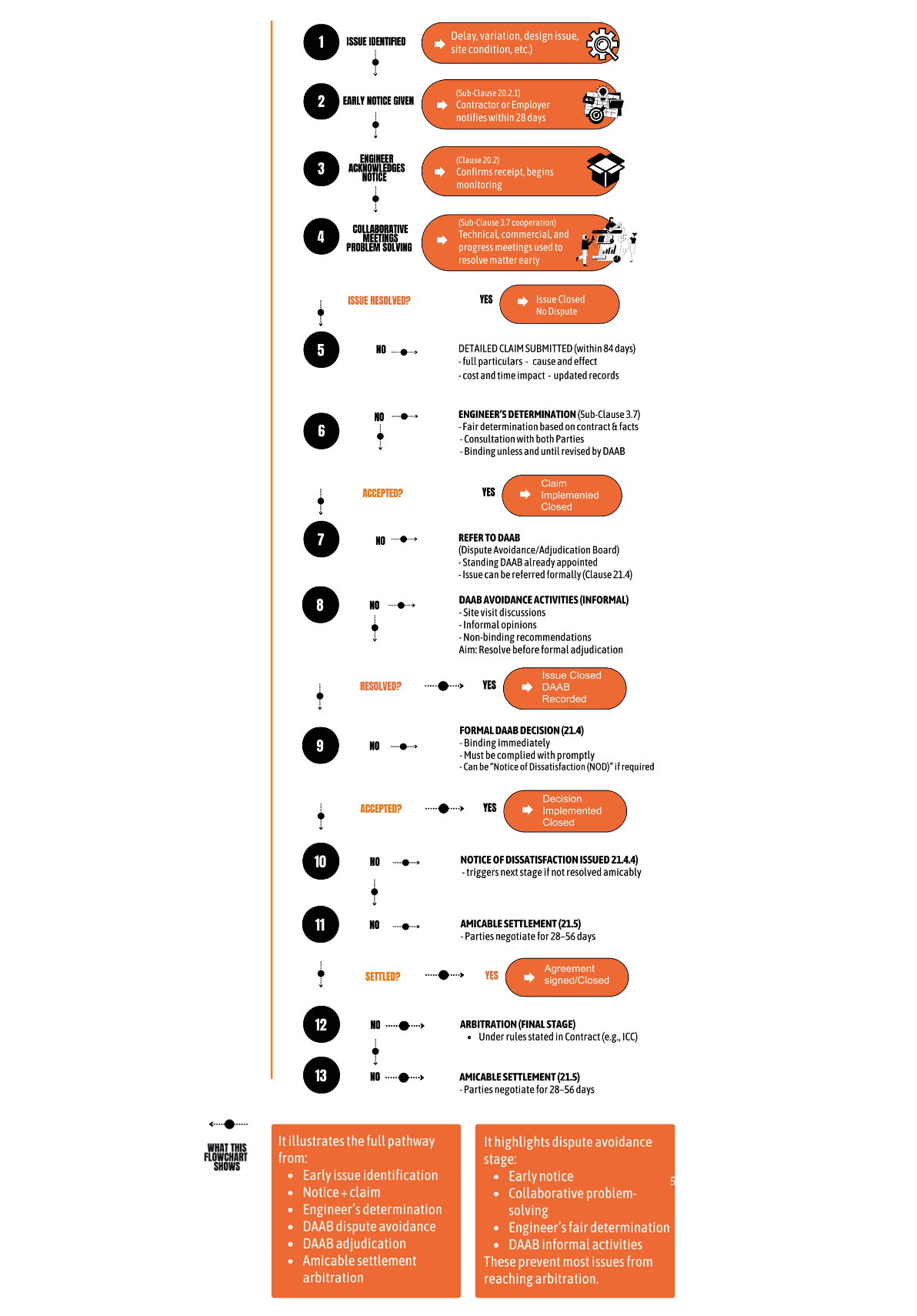
FIDIC also establishes strict notice and claims procedures. Contractors must provide notice within 28 days and submit detailed claims within 84 days. These procedures ensure that potential issues are identified early and addressed transparently (see flow chart).
Programme updates, notices of errors in documents and early identification of risks further support this proactive approach (see flow chart).
The DAAB: the core of FIDIC dispute avoidance
One of the most significant innovations in the FIDIC 2017 contracts is the introduction of a standing Dispute Avoidance/Adjudication Board (DAAB).
Unlike earlier editions, the DAAB is appointed at the start of the project rather than only when disputes arise. Its role is twofold.
First, the board actively engages in dispute avoidance, conducting site visits, participating in discussions and issuing informal recommendations. These interactions allow issues to be addressed early, often before formal claims are submitted (see flow chart).
Second, if avoidance efforts fail, the DAAB provides binding adjudication decisions, ensuring that disputes can be resolved quickly without immediately escalating to arbitration (see flow chart).
Regular DAAB activities—such as progress reviews, risk discussions and informal guidance—often enable parties to resolve issues long before they reach arbitration.
These external consultants review progress, quality and contractual compliance, providing an objective perspective that can help defuse disagreements between contractors and employers.
A structured pathway for dispute prevention
The FIDIC system therefore establishes a structured pathway for managing issues from the moment they arise.
Typically, a potential issue is first identified on the project and formally notified. The Engineer then reviews the matter and facilitates discussions between the parties to attempt early resolution (see flow chart).
If necessary, a detailed claim may be submitted, followed by a formal determination by the Engineer. Only when these mechanisms fail is the matter referred to the DAAB for dispute avoidance or adjudication (see flow chart).
This structured process allows most issues to be addressed progressively before reaching formal dispute stages.
A system, not a single mechanism
Ultimately, dispute avoidance in construction is not achieved through a single clause or procedure. It is the result of a coordinated system combining clear contracts, proactive management, collaborative behaviour, strong documentation and continuous monitoring.
When these mechanisms work together effectively, they reduce the likelihood of formal disputes, improve project outcomes and preserve professional relationships.n an industry where projects are complex, capital-intensive and time-sensitive, the ability to prevent disputes rather than resolve them after the fact may be one of the most valuable capabilities of all.
...